 of each weight, as a force vector?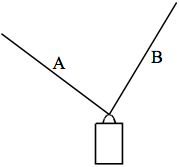
b) In which string should the force be larger?
c) Set up that situation, measure the angle of each string, and record the scale measurements. Give the vector form of each force. Then, find the net force. It should be nearly zero (within about .5 in each coordinate).
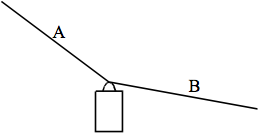
b) In which string should the force be larger?
c) Set up that situation, measure the angle of each string, and record the scale measurements. Give the vector form of each force. Then, find the net force. It should be nearly zero (within about .5 in each coordinate).
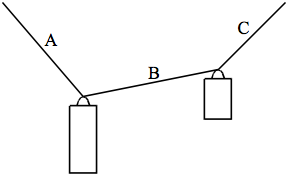
b) Here, it is difficult to measure the force in the middle string. So, instead, we'll treat both objects as one single object. Its weight will be their combined weights, and it will have just the two outside tension forces acting on it.
Find the vector form of each force, and from that find the net force.
c) Extra Credit: Find the tension force the middle string exerts on each weight.